The YouTube Keyword System: How to Choose Keywords That Pull Views and Build a Channel That Lasts
Most videos do not fail because the content is bad
For a while I believed the comforting version of this job: make something good, and the algorithm will go and find the right people for it. Then I spent a long stretch pulling apart channels aimed at English-speaking audiences — hundreds of them, competitors and case studies both — and I had to revise that belief fairly hard.
An enormous share of videos that go nowhere are not badly made. They are badly addressed. The creator is saying one thing while the audience is searching for another, and the two never meet. The video is fine. Nobody asked the question in those words.
That is why youtube keyword research is not a box you tick at the end of production. It is the layer underneath the whole channel.
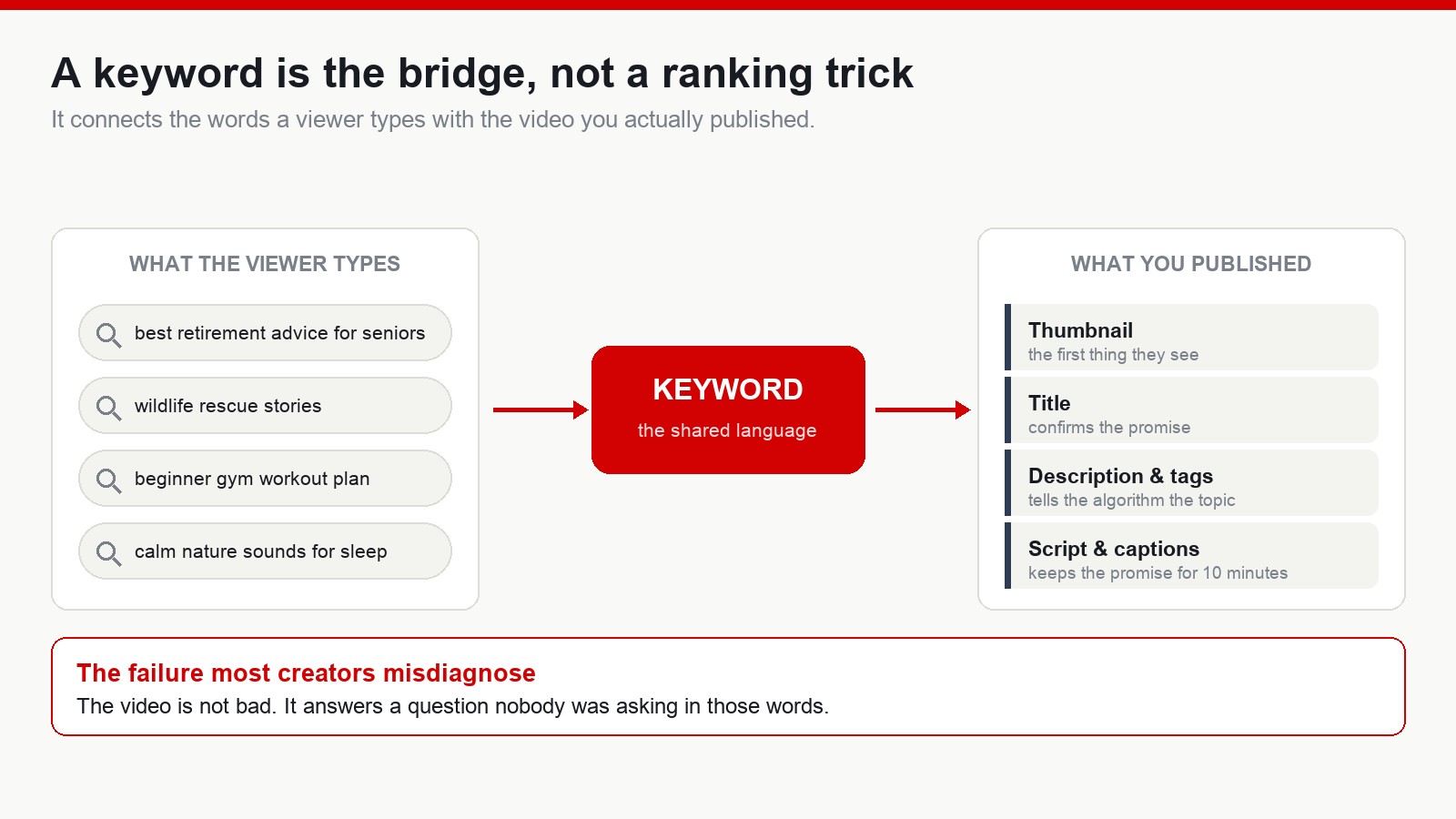
A keyword is not just an SEO input
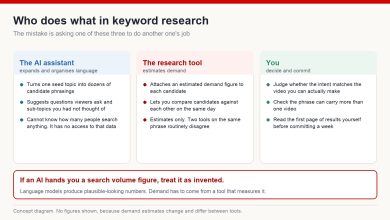
Say the word keyword and most people immediately think search, ranking, tags. Fair enough — that is where the term comes from. But in practice a keyword is doing something more useful than that. It tells you:
- What your audience actually wants
- What they are currently paying attention to
- What language they use when they describe the problem to themselves
A good keyword does not only help a video get surfaced. It helps a video get clicked, because it is written in the viewer’s own vocabulary rather than yours. Those are two different jobs, and most creators optimise for only the first one.
The two kinds of keywords that matter most
When I research a topic I sort every phrase I find into one of two buckets. It is a crude split and it works.
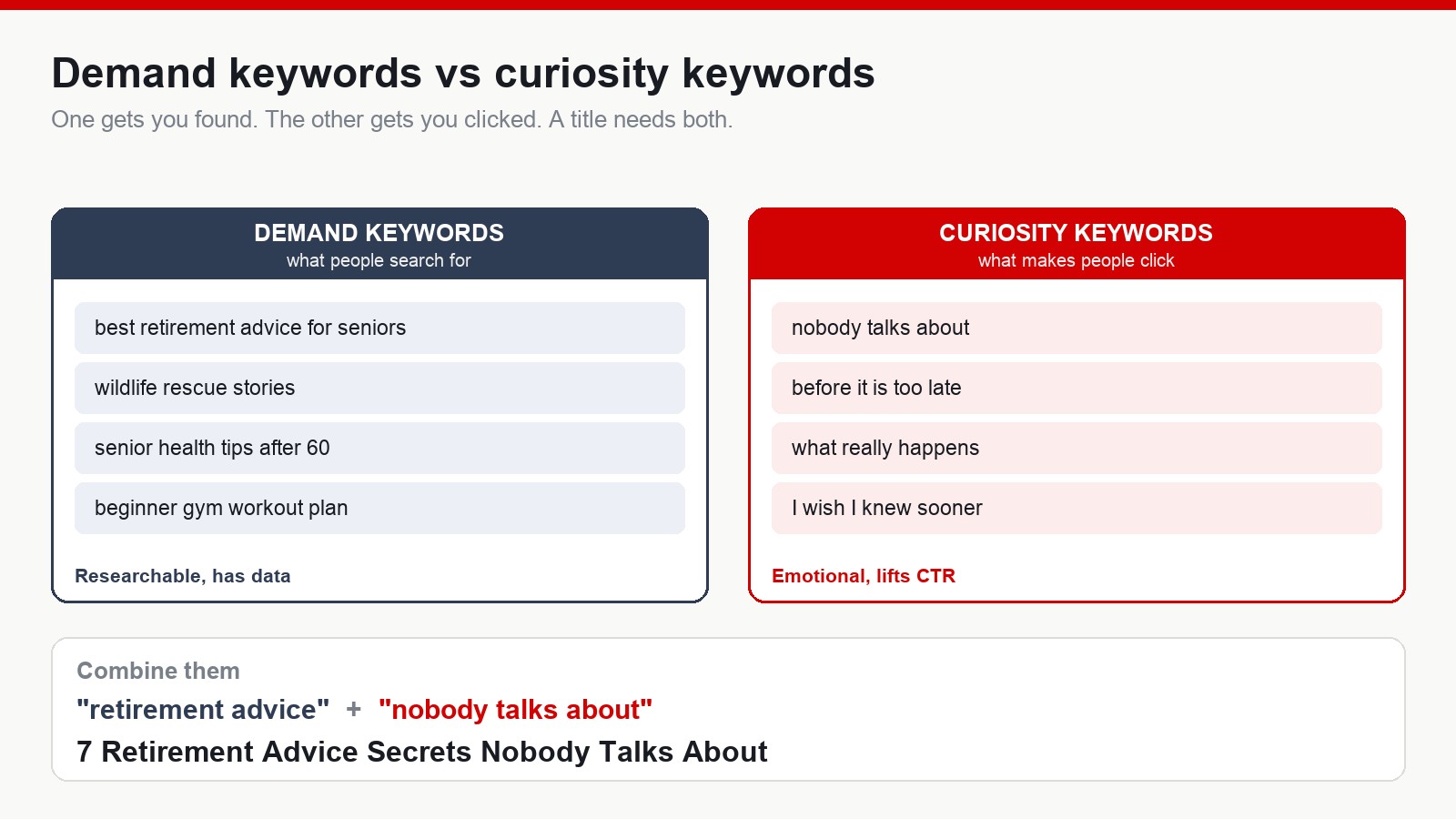
Demand keywords
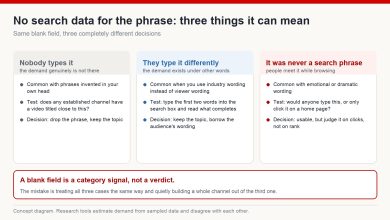
These reflect something a real person is actively looking for. They are researchable — you can pull volume and competition numbers on them in vidIQ or TubeBuddy. Examples:
- best retirement advice for seniors
- wildlife rescue stories
- senior health tips after 60
- beginner gym workout plan
The defining feature is that there is data behind them and the intent is unambiguous. Channels built on this bucket tend to grow steadily rather than spikily.
Curiosity keywords
These are the emotional phrases. They carry no search volume worth speaking of, and that is not their job. Their job is to raise click-through rate. Examples:
- nobody talks about
- before it is too late
- what really happens
- I wish I knew sooner
What goes wrong when you use only one kind
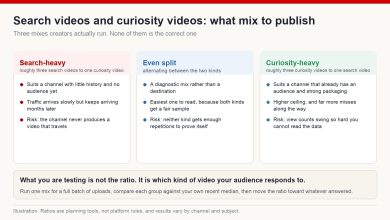
Lean entirely on demand keywords and you end up with a title that is technically correct and completely inert. Senior Health Tips describes the video accurately. It also gives nobody a reason to stop scrolling.
Lean entirely on curiosity keywords and you get the opposite problem. Nobody Saw This Coming might pull a decent click-through rate from the people who happen to see it, but neither a viewer nor the recommendation system can tell what the video is about. You have made yourself impossible to categorise.
The combination
Take the demand phrase retirement advice and the curiosity phrase nobody talks about, and you get:
7 Retirement Advice Secrets Nobody Talks About
Now the viewer knows what they are getting, the algorithm knows how to file it, and there is still a reason to click. That is the whole trick, and it is not much of a trick — it is just refusing to give up either half.
The three-tier keyword funnel
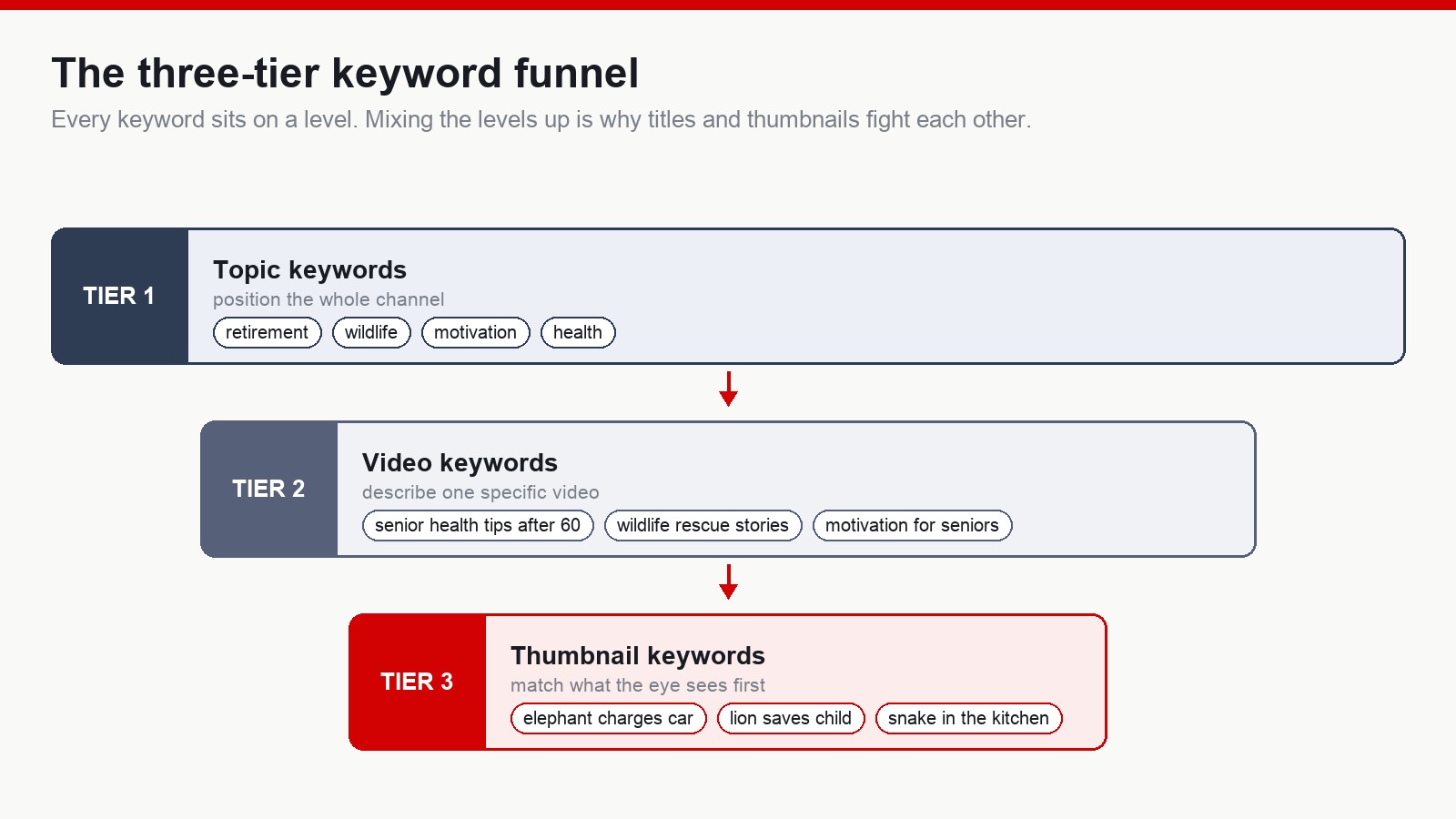
The second idea that changed how I work is this: not all keywords sit at the same level. They belong to different tiers, and treating a tier-one term like a tier-three term is why so many titles and thumbnails end up arguing with each other.
Tier 1: topic keywords
The broadest layer. Terms like retirement, wildlife, motivation, health. These do not belong in a video title — they position the entire channel. This is the layer you settle first when you are choosing what a new channel is even about.
Tier 2: video keywords
More specific. Senior health tips after 60. Wildlife rescue stories. Motivation for seniors. This layer describes one particular video and nothing else, and it is where most of your research time should go.
Tier 3: thumbnail keywords
The layer closest to raw viewer behaviour. Elephant charges car. Lion saves child. Snake in the kitchen. These are less phrases people type and more images people react to, and they are usually the first thing a viewer processes.
The thumbnail usually beats the search box
Plenty of creators optimise their keywords beautifully and then forget the order in which a human actually consumes a listing. The image lands first. The title is read second, and only if the image bought enough attention to earn it.
So if your thumbnail shows an elephant bearing down on a vehicle and your title is a reflective piece about ageing gracefully, you have created a small moment of confusion at the exact instant you could least afford one. Tier-three keywords and tier-two keywords need to be telling the same story.
Long-tail keywords: the part most people skip
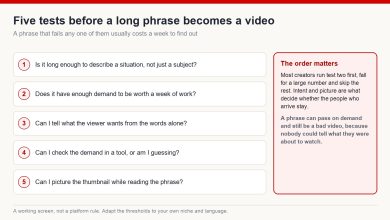
Most creators fixate on short terms, because short terms have the impressive numbers next to them. But a longer phrase carries something a short one cannot: a clearly stated need.
Instead of retirement, try best retirement health tips for seniors. Instead of gym, try beginner gym workout plan at home.
Long-tail phrases tend to be:
- Less contested, because the large channels are not aiming at them
- Closer to a specific need, so the video can actually satisfy it
- Better at converting a viewer into a subscriber, because you delivered exactly what was asked for
Fewer people, better matched. On a young channel that trade is almost always the right one.
Breaking competitor titles into parts
This is the research habit I enjoy most, and it costs nothing. Take a title that is clearly working in your niche — say 10 Retirement Mistakes Seniors Regret — and pull it apart into its components:
- retirement mistakes
- seniors regret
- retirement advice
- senior lifestyle
Then research each fragment on its own. What you tend to surface is not the original topic but the angles around it that nobody has covered yet, because everybody else was looking at the title as a single object rather than a set of parts.
The same video, two different audiences
Here is the idea I find genuinely interesting: the identical footage, framed with different keywords, will attract completely different people.
Take one nature video. Title it Wildlife Rescue Story and you gather people who care about animals. Title it Peaceful Nature Moments Before Sleep and you gather people looking to wind down at the end of the day.
Same content. Two audiences with different expectations, different session behaviour and different reasons for being there. That is how much steering power sits in the words alone — which is also a caution. Choose the framing that matches what the video honestly delivers, not the one with the bigger number, or you will win the click and lose the retention.
Do keywords in a channel name help?
Some creators pair a brand word with a topic word, so the name signals the subject immediately:
- Nature Echo – Wildlife
- Senior Wisdom – Health
- Calm Journey – Motivation
It is a reasonable way to make your positioning obvious from the first impression. But keep it in proportion. A channel name is a supporting detail; nothing about it will rescue content that does not hold attention.
A six-step routine you can repeat
Everything above collapses into a loop I run for every channel:
- Step 1. Fix the topic keyword that defines the channel.
- Step 2. Build a working list of video keywords underneath it.
- Step 3. Find the thumbnail keywords that match those videos visually.
- Step 4. Combine demand keywords with curiosity keywords in every title.
- Step 5. Track click-through rate and retention on what you publish.
- Step 6. Adjust, and run it again.
None of it is complicated. The difficulty is that step six never ends, and most people quit somewhere around the third cycle, right before the data starts telling them anything useful.
What this all comes down to
A keyword is not an SEO input. It is the shared language between a viewer, a recommendation system and your content. Once you see it that way, you stop producing videos on instinct and start producing them against something people have already told you they want.
So the next time you sit down to research, do not stop at which keyword has the most searches. Ask the second question too: which keyword reflects what my viewer actually feels about this problem. On YouTube the winning video is rarely the one carrying the most keywords. It is the one that says the thing somebody was already hoping to find.
Two honest caveats before you go. Search volume figures are estimates and they move, so treat them as a way to compare terms rather than as facts. And the platform changes its recommendation behaviour regularly, which means any keyword system is a working method, not a guarantee. Results vary, and anyone claiming otherwise is not being straight with you.
Frequently asked questions
What is a demand keyword?
A phrase that reflects a real need and can be researched through search data. It is what gets your video found.
What is a curiosity keyword?
An emotional or trend-driven phrase used to raise click-through rate. It carries little search volume of its own.
Should I only chase high-volume keywords?
No. Longer, more specific phrases often bring a smaller but far better-matched audience, which matters more on a young channel.
Is the thumbnail connected to keyword choice?
Yes. The thumbnail is the first thing a viewer processes, so the idea it communicates should match the keyword in the title rather than compete with it.
If you are building a faceless channel for an English-speaking audience and you would rather work from a structured keyword process than piece one together from scattered advice, that is what I teach at mmoyoutube.com.